A coding assessment test is a structured evaluation tool that measures a candidate's programming ability, problem-solving skills, and technical knowledge through hands-on coding challenges or questions. For technical hiring managers and engineering leads, choosing the right assessment format directly impacts both the quality of your hires and the candidate experience—poor test design drives away top talent while failing to predict on-the-job performance. This guide explains the core formats, scoring approaches, and strategic considerations for implementing coding assessments that actually work.
What Is a Coding Assessment Test?
A coding assessment test evaluates a candidate's technical competency by requiring them to write, debug, or analyze code under specific conditions. Unlike resume screening or behavioral interviews, these tests provide empirical data about how candidates approach technical problems, structure their code, and handle real-world constraints like time pressure or incomplete requirements.
The primary purpose is to filter candidates efficiently at scale while gathering objective performance data before investing in live interview time. When designed correctly, coding assessments meaningfully cut down time-to-hire by surfacing only candidates who meet your technical bar, but poorly designed tests create false negatives that cost you qualified engineers and damage your employer brand.
Coding assessments differ from technical interviews in their asynchronous nature and standardization—every candidate receives the same questions under the same conditions, which provides consistency that live interviews often lack. However, assessments cannot fully replace human evaluation of communication skills, architectural thinking, or cultural fit, which is why many teams use them as a pre-screen before engaging their Interview as a Service resources or internal interviewers.
Main Coding Assessment Formats
The format you choose signals what you value and directly affects which candidates succeed. Each format tests different competencies and introduces different biases, so understanding the trade-offs is essential for matching assessment design to role requirements.
Multiple Choice and Theoretical Questions
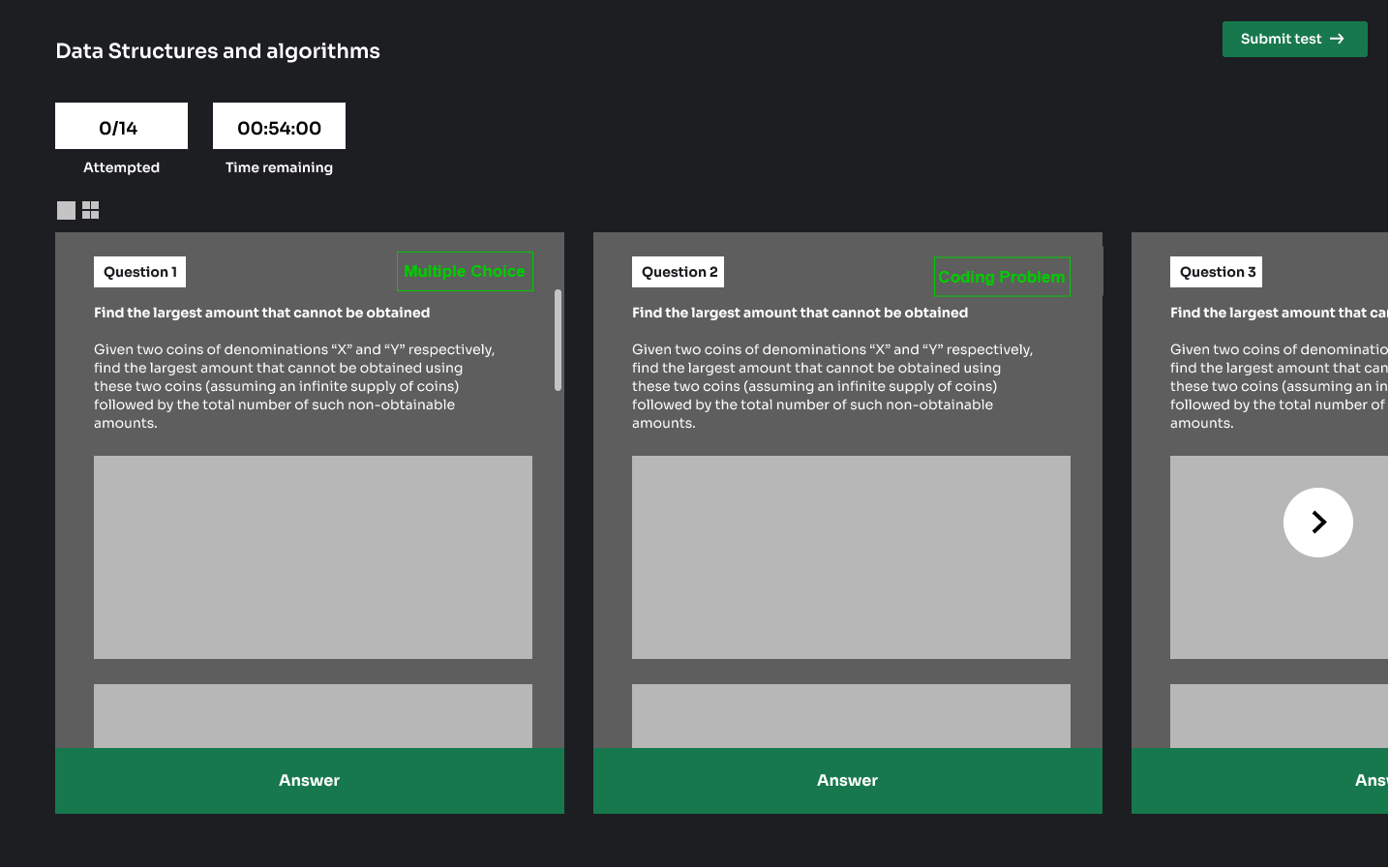
Multiple choice coding assessments test conceptual knowledge, language syntax, algorithm complexity, and code comprehension without requiring candidates to write functioning code. Questions typically show code snippets and ask candidates to predict output, identify bugs, or select the correct implementation approach.
This format works well for initial screening at high volume or for roles requiring deep framework knowledge where syntax familiarity matters. However, multiple choice questions poorly predict coding ability—a candidate can recognize correct code without being able to produce it—and they are easily gamed through memorization or lucky guessing.
Sample question formats include: predicting code output given specific inputs, identifying time complexity of algorithms, selecting correct API usage patterns, spotting security vulnerabilities in code snippets, or choosing appropriate data structures for described scenarios.
Live Coding Challenges
Live coding assessments require candidates to solve problems in real-time within a browser-based IDE, typically with a countdown timer ranging from 30 to 90 minutes. The platform executes code against hidden test cases and provides immediate feedback on correctness, with most systems tracking metrics like time to completion, number of submissions, and code efficiency.
This format closely mimics the pressure of technical interviews and provides strong signals about problem-solving speed and coding fluency. Live coding works exceptionally well for screening junior to mid-level engineers where algorithmic thinking and implementation speed are core job requirements.
The major weakness is that timed pressure creates artificial stress that does not reflect normal working conditions, disadvantaging candidates who perform better with time to research and reflect. Additionally, the focus on algorithmic puzzles often fails to predict success in roles centered on system design, debugging legacy code, or collaborative development.
Common question formats include: implementing algorithms with specific complexity requirements, manipulating data structures to solve logic puzzles, parsing and transforming text or data, solving dynamic programming challenges, or writing functions that pass a series of increasingly complex test cases.
Take-Home Assignments
Take-home coding assessments give candidates several days to complete a more substantial coding task in their own environment using their preferred tools. Assignments typically involve building a small feature, implementing a service with specific requirements, or refactoring existing code, with submissions evaluated on code quality, architecture, testing, and documentation.
Take-homes eliminate time pressure and allow candidates to demonstrate how they actually work, including their approach to testing, error handling, code organization, and documentation. This format provides the richest signal for senior roles where architectural decisions and code maintainability matter more than algorithmic speed.
The significant downside is time investment—both for candidates who may spend 4-8 hours on assignments and for reviewers who must carefully evaluate each submission. Take-homes also introduce equity issues since candidates with family responsibilities or multiple interview processes cannot invest equal time, and you cannot verify that the candidate completed the work independently.
Typical assignment formats include: building a REST API with specific endpoints and data models, creating a small web application with given functionality, implementing a data processing pipeline, refactoring a provided codebase to improve design, or adding features to an existing open-source project.
Project-Based and Simulation Assessments
Project-based assessments simulate real work scenarios by providing candidates with a realistic codebase, documentation, and business requirements, then asking them to debug issues, add features, or make architectural decisions. These assessments range from 1-3 hours and focus on practical skills like reading unfamiliar code, working with APIs, and making pragmatic trade-offs.
This format provides the highest predictive validity for job performance because it directly samples the work candidates will actually do—reading documentation, debugging in unfamiliar codebases, and delivering features under realistic constraints. Project-based tests are particularly effective for mid-level to senior engineers and for specialized roles like DevOps, data engineering, or full-stack development.
Implementation requires more upfront investment to create realistic scenarios and codebases, and scoring is less automated since evaluators must assess decision-making and approach rather than just correctness. However, the improved candidate experience and prediction accuracy justify this investment for companies serious about reducing mis-hires.
Common formats include: debugging a failing test suite in a real application, implementing a feature in an existing codebase with incomplete documentation, optimizing performance of a slow endpoint, integrating a third-party API into an existing system, or proposing and implementing a solution to a described technical problem.
How Scoring and Rubrics Work
Objective scoring rubrics transform subjective code evaluation into consistent, defensible hiring decisions. Without clear rubrics, different reviewers apply different standards, introducing bias and reducing the assessment's predictive power.
Automated Scoring Systems
Automated scoring runs candidate code against a test suite and assigns points based on how many test cases pass, typically with different weights for edge cases versus basic functionality. Most platforms also measure secondary metrics like execution time, memory usage, code complexity, and time to completion, though these metrics should be used cautiously since they can penalize thoughtful candidates who test edge cases or refactor.
Pure automated scoring works only for problems with objectively correct answers and fails to evaluate code quality, readability, or architectural appropriateness. Relying solely on pass/fail metrics incentivizes candidates to hack together solutions that technically work but would be unmaintainable in production, which is why automated scores should represent only 50-70% of the total evaluation for any role above junior level.
Manual Code Review Rubrics
Effective manual rubrics break evaluation into 4-6 specific dimensions with clear criteria for each level. Standard dimensions include correctness and completeness, code quality and readability, efficiency and optimization, error handling and edge cases, testing approach, and documentation quality.
A practical rubric might score code quality on a 4-point scale: 1 point for code that works but is difficult to follow with poor naming and structure, 2 points for readable code with reasonable organization but inconsistent patterns, 3 points for clean code following language conventions with clear intent, and 4 points for exemplary code that would improve the quality of your existing codebase. Each dimension should include concrete examples of what distinguishes each level.
Rubric calibration sessions where multiple reviewers independently score the same submissions and then discuss discrepancies are essential for consistency. Without calibration, different reviewers unconsciously weight different factors, with some prioritizing algorithmic efficiency while others focus on readability, leading to inconsistent candidate experiences and potentially discriminatory outcomes.
Weighted Scoring for Role Requirements
Different roles require different competencies, so your scoring should reflect what actually matters for success. A DevOps engineer role should heavily weight error handling and operational thinking, while a data engineering role should emphasize efficiency and scale considerations, and a frontend role should prioritize user experience and code organization over algorithmic optimization.
Implement weighted scoring by assigning percentage weights to each rubric dimension based on role requirements, then calculating a composite score. For example, a senior backend role might weight correctness at 25%, code quality at 30%, efficiency at 20%, testing at 15%, and documentation at 10%, while a junior role might weight correctness at 40% and reduce the testing and documentation expectations.
Picking the Right Format and Difficulty for Each Role
Format selection should be driven by what competencies predict success in the specific role and level, not by what is easiest to administer or what other companies do. Mismatched assessments waste everyone's time and drive away qualified candidates who recognize the disconnect between your test and the actual job.
Matching Format to Seniority Level
For junior engineers, live coding challenges testing fundamental data structures, algorithms, and language proficiency provide sufficient signal at low cost. Junior candidates typically lack the experience to excel at architectural decisions or unfamiliar codebase navigation, so testing those skills creates false negatives while the ability to implement clean solutions to well-defined problems strongly predicts ramp-up success.
Mid-level engineers should face either extended live coding sessions with more complex problems requiring multiple components or shorter take-home assignments emphasizing code quality and testing. At this level, you are evaluating whether candidates can work independently on features, so assessments should require making small architectural decisions, handling edge cases thoughtfully, and writing maintainable code without supervision.
Senior and staff engineers require take-home or project-based assessments that evaluate architectural thinking, code review ability, and pragmatic trade-off analysis. Algorithmic puzzle-solving provides almost no signal for senior roles where the core competencies are system design, mentoring through code review, and making decisions under uncertainty, so leetcode-style tests actively harm your ability to identify strong senior candidates.
Matching Format to Role Type
Backend engineers benefit from assessments involving API design, database interaction, and system integration rather than pure algorithms. Effective formats include implementing a service with specific performance requirements, designing and implementing a data model for described requirements, or debugging performance issues in a provided application.
Frontend engineers should face assessments involving component implementation, state management, and user interaction rather than algorithmic challenges. Project-based assessments that provide designs and require building interactive features with specific behavior provide much stronger signal than algorithm problems that rarely appear in frontend work.
Full-stack roles require assessments that touch both frontend and backend concerns, typically through small feature implementations that involve API changes and UI updates. Take-home assignments work particularly well here since they allow candidates to demonstrate how they think about the complete feature lifecycle rather than optimizing one narrow slice.
Specialized roles like data engineers, ML engineers, DevOps engineers, or security engineers require domain-specific assessments that test the actual skills they will use. Generic coding tests provide weak signal for these roles—a data engineer should work with realistic data pipelines and transformations, not implement binary tree traversals.
If you are struggling to design role-specific assessments or need expert interviewers who can evaluate beyond automated test cases, platforms that provide both assessment tools and experienced technical interviewers can significantly improve your hiring outcomes.
Difficulty Calibration
Assessment difficulty should be calibrated so that qualified candidates succeed 70-80% of the time—if your pass rate is below 50%, your test is either too difficult or poorly designed, and if it exceeds 90%, it is not providing sufficient differentiation. Track pass rates by candidate source, demographics, and role level to identify when your assessments are introducing unintended bias or failing to predict performance.
Adjust difficulty by changing time constraints, problem complexity, or the completeness of provided scaffolding rather than by adding more problems. A single well-designed problem that takes 60 minutes provides more signal than three 20-minute problems because it allows you to evaluate how candidates handle complexity, refactor as they go, and test their work, which are the skills that matter in real development.
Before deploying any new assessment, have 3-5 engineers at the target level complete it and gather feedback on clarity, time requirements, and relevance. If your own engineers struggle to complete the assessment in the allotted time or question its relevance to the role, candidates will have the same experience, and you will lose strong applicants who correctly recognize a poorly designed evaluation.
Common Pitfalls in Coding Assessment Design
Even well-intentioned assessment programs fail when they optimize for convenience over validity or copy practices from companies with different hiring contexts. Understanding common failure modes helps you avoid wasting resources on tests that do not improve hiring outcomes.
The Leetcode Problem
Leetcode-style algorithmic puzzles have become the default coding assessment despite overwhelming evidence that they poorly predict job performance for most software engineering roles. These problems test a narrow skill—solving unfamiliar logic puzzles under time pressure—that bears little resemblance to the daily work of most engineers, who spend their time reading documentation, debugging existing systems, collaborating on design, and making pragmatic trade-offs.
Leetcode tests introduce multiple biases: they favor candidates with time to practice hundreds of problems over candidates with family responsibilities, they favor recent computer science graduates over experienced engineers who have not studied algorithms recently, and they favor candidates willing to game the system over candidates who prioritize learning skills relevant to the actual job. Companies that rely heavily on algorithmic puzzles consistently struggle to hire experienced engineers and diverse candidates while wondering why their hiring process feels broken.
The alternative is work-sample tests that directly simulate job tasks. If your engineers spend their days building features in existing codebases, your assessment should involve building a feature in an existing codebase. If they spend their time debugging production issues, your assessment should involve debugging. The closer your assessment resembles actual work, the better it predicts performance and the more respect it earns from senior candidates.
Excessive Assessment Length
Assessments longer than 90 minutes for live coding or requiring more than 4 hours for take-homes drive away employed candidates who are interviewing while working full-time. Your assessment competes with every other company's assessment for candidate time, and lengthy tests signal that you do not respect candidate time or do not understand how to evaluate efficiently.
Design assessments that provide maximum signal in minimum time by focusing on one or two well-crafted problems rather than comprehensive coverage of every possible skill. A single 60-minute problem that requires reading code, identifying an issue, implementing a fix, and testing it provides more insight into real capability than five 20-minute algorithmic puzzles, while respecting that strong candidates have options.
Unclear Instructions and Requirements
Ambiguous problem statements, unclear success criteria, or missing information about evaluation criteria create frustration and introduce noise into your results. When candidates must guess what you want, you are testing their ability to read your mind rather than their technical ability, and you will systematically penalize candidates who ask clarifying questions or consider edge cases you forgot to specify.
Write instructions that specify exactly what the code should do, what inputs and outputs to expect, what edge cases to handle, and what aspects of the solution will be evaluated. Include example inputs and outputs, specify whether to optimize for speed or readability, and clarify whether candidates should use specific libraries or approaches. The goal is to eliminate ambiguity so that performance differences reflect actual skill differences rather than lucky guesses about your expectations.
Ignoring Accessibility and Accommodation
Standard coding assessments create barriers for candidates with disabilities, non-native English speakers, or candidates using assistive technologies. Timed tests disadvantage candidates who need extra processing time, browser-based IDEs may not work with screen readers, and complex problem statements with unnecessary jargon penalize non-native speakers without testing relevant skills.
Provide reasonable accommodations including extended time, alternative formats, and clear language in problem statements. Test your assessment platform with screen readers and keyboard-only navigation, offer the option to complete assessments in a candidate's preferred IDE rather than a browser, and review problem statements to remove unnecessary complexity and jargon. These accommodations improve the experience for all candidates while ensuring you do not inadvertently exclude qualified engineers.
No Validation Against Job Performance
Most companies never validate whether their coding assessments actually predict job performance, instead assuming that because other companies use similar tests, they must work. Without validation, you cannot know whether your assessment is filtering for the right skills or systematically excluding strong candidates while passing weak ones.
Track assessment scores for all hires and correlate them with performance review ratings, manager satisfaction, and retention after 6-12 months. If you find no correlation or negative correlation between assessment scores and job performance, your test is broken and needs redesign. Strong correlations validate your assessment design and justify the candidate time investment, while weak correlations indicate you are testing the wrong skills or using the wrong format for your roles.
Related Guides
For deeper dives into specific aspects of technical assessment strategy, see our guides on Best Technical Skills Assessment Platforms for platform selection criteria, The Ultimate Cheat Sheet On Coding Assessment for quick reference on assessment design, and Coding Test Strategies for Effective and Efficient Hiring for implementation tactics that reduce time-to-hire.
Frequently Asked Questions
What is a good pass rate for coding assessment tests?
A well-calibrated coding assessment should have a pass rate between 20-40% of all candidates who attempt it, and 70-80% of candidates who reach the assessment stage after resume screening. Pass rates below 10% indicate your test is too difficult or poorly designed and is likely creating false negatives, while pass rates above 50% suggest the assessment is not providing sufficient differentiation between candidates. Track pass rates by source, role, and demographics to identify whether your assessment is introducing unintended bias.
How long should a coding assessment test take to complete?
Live coding assessments should take 45-90 minutes maximum, while take-home assignments should require no more than 3-4 hours of focused work. Longer assessments drive away employed candidates who are interviewing while working full-time and signal that you cannot evaluate efficiently. If you feel you need more time to assess candidates, you are likely testing too many things at once—focus on the 2-3 competencies that most strongly predict success in the role and design a shorter, more focused assessment that respects candidate time.
Should candidates be allowed to use the internet during coding assessments?
Yes, candidates should be allowed to access documentation, Stack Overflow, and other reference materials during coding assessments because that is how engineers actually work. Prohibiting internet access tests memorization rather than problem-solving ability and creates artificial conditions that do not reflect job performance. The goal is to evaluate how candidates solve problems with realistic resources available, not to test whether they have memorized syntax or API signatures. Design problems that require understanding and application rather than simple lookup, so that internet access helps but does not eliminate the need for actual skill.
Final Thoughts
Coding assessment tests provide essential efficiency and objectivity in technical hiring, but only when the format, difficulty, and evaluation criteria align with actual role requirements and job performance predictors. The most common mistake is copying assessment practices from other companies without validating whether those practices work in your context—what works for hiring algorithms researchers at a big tech company will fail when hiring full-stack engineers at a product company. Invest time in designing role-specific assessments, calibrating difficulty based on your own pass rate data, and validating that assessment scores correlate with job performance, and your assessments will become a competitive advantage rather than a candidate experience liability.
![How to learn programming from scratch [2025 guide]](https://cdn.prod.website-files.com/60cca9384ff7eaa931a24b69/6a2053e9938c77c94bb24c53_6a1ebc87c249b70ae53a5fc4_How-To-Learn-Programming-From-Scratch--2025-Guide---1-.png)